Friday, November 20, 2015

Celebration ale spent grain bread

Last weekend my husband brewed Oak Barrel Winecraft's seasonal Celebration Ale, which features 1 part barley to 2 parts crystal malt 40L. It also includes sugars and spices, but I'm not sure how much of those made their way into the grains.

So what the heck is crystal malt 40L? According to Brew365, it's a type of crystal/caramel malt produced from wheat rather than barley. "The process darkens the wheat malt (from 3L to 38-53L) and produces nonfermentable sugars. The roasting process produces a caramel, roast, moderately sweet flavor in addition to keeping the mouthfeel properties of the base wheat malt." It's used in dark beers. Judging from the range of 38-53L, it sounds like crystal malt 40L is one of the lighter dark wheat malts.

Barley and crystal malt 40L, after brewing

After brewing, the spent grain smelled much less sweet than the Hefeweizen leftovers. This spent grain did, however, make for some tasty, dark bread. I'll call it Celebration bread.

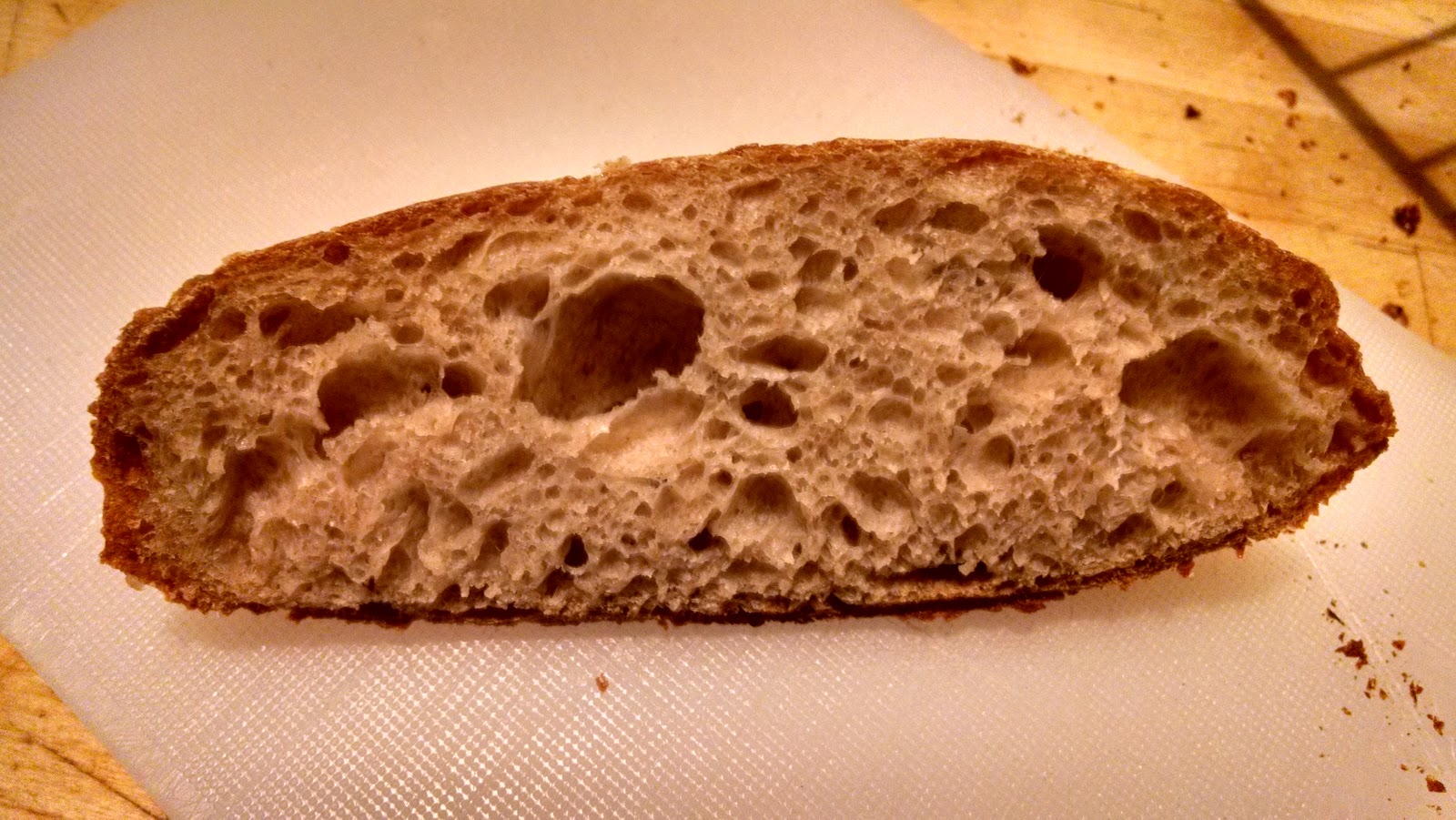
Dense crumb around the edges

I used the same recipe as before: Snappy Service Cafe's Homebrewed to Home Baked: Spent Grain Bread. The only difference from before was the different spent grain and the fact that I accidentally left the bread in the breadmaker for a few hours after baking. The extended time in the Zo didn't seem to harm the Celebration bread, but it might have contributed to the dense crumb along all the outside edges of the bread.

Although I made the same adjustments as before (search for "details" in my previous post), the Celebration bread had a very different texture, color, and flavor from the Hefeweizen bread. The texture wasn't as light, perhaps because of being trapped in the breadmaker. During the mixing cycle, I checked on the consistency, and it was more solid (in a good way) than the wetter Hefeweizen dough. The color of the Celebration bread was darker, more like a pumpernickel. Interestingly, the flavor was also more like pumpernickel—bittersweet, with molasses overtones. Each time I had the Celebration bread, the first bite seemed a little too bitter, but by the last bite I loved it.

I ate the Celebration bread both alone and with tuna fish. Delicious!

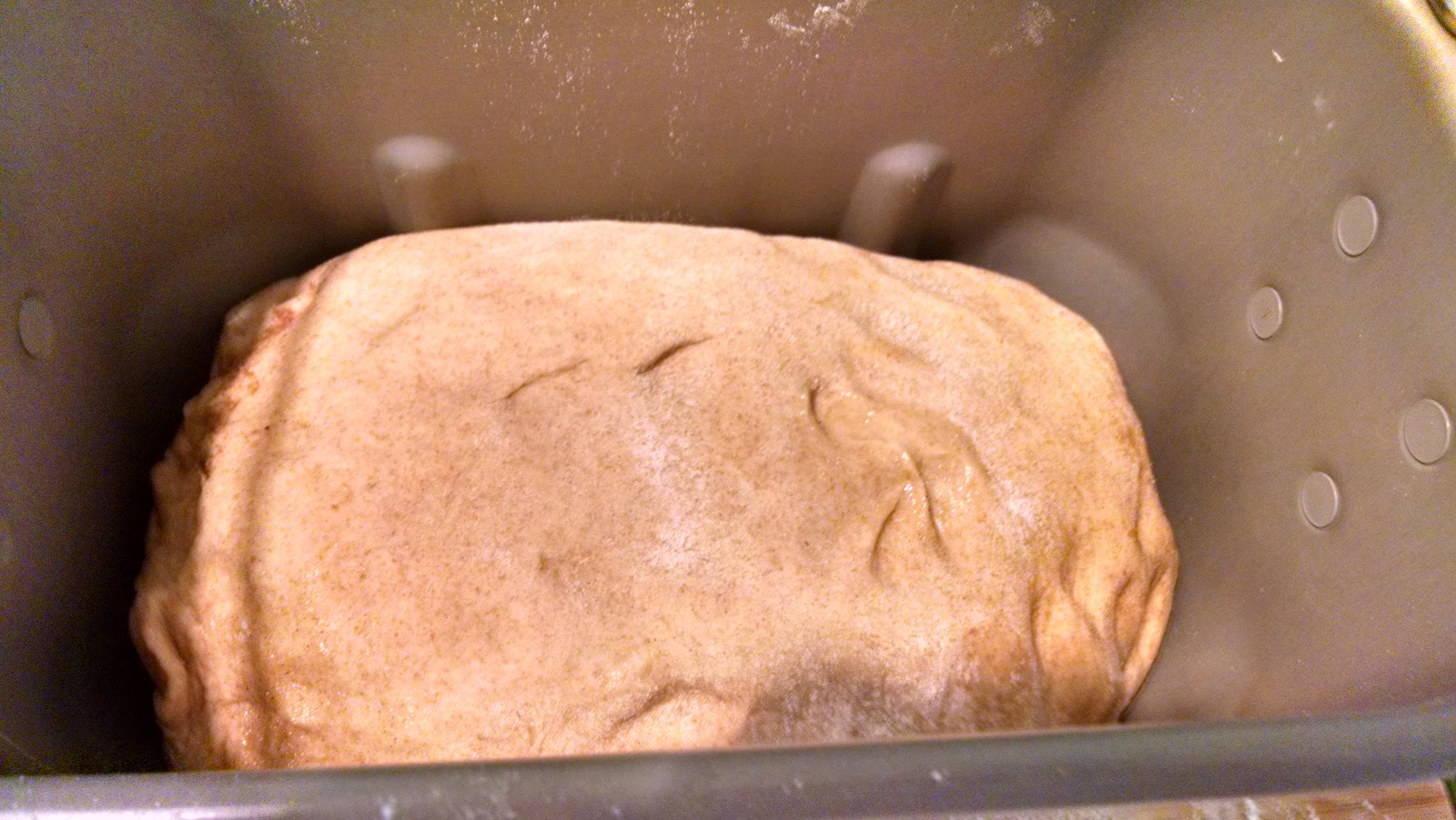
Next time I might try a different oil. I'll probably also reduce the recipe to produce something closer to a 1.5# loaf. This bread was ridiculously tall. Never before have I made a machine-baked loaf that barely fit into the breadbox.

Squeezed into the breadbox


Wednesday, November 11, 2015

Hefeweizen & penuche breads, plus terminology

As I mentioned in my last post, I had some wonderful smelling grain left over from my husband's wheat beer brewing; I put it into some bread. Then last week I made some cinnamon bread that I've made before, which has what Hensperger calls a penuche filling. I also made toasted sesame whole-wheat bread (great with tuna sandwiches!) but that's an old standby; nothing new to say there.

Before I get into the bread, let me geek out about words.

Today's words: Hefeweizen & penuche

At least one northern German I've met has expressed bemusement at the term Hefeweizen, saying the Hefe was unnecessary: it's just wheat beer (Weizen or Weizenbier), as opposed to yeast-wheat beer. (I'm always tempted to think of Hefe as meaning "boss", like the Spanish jefe, but it really means yeast.) Wheat beer names differ by language, brewing region, and recipe variation. Many of the German names have Weiss instead of Weizen in them. Weiss means white and, interestingly, in both English and German weiss/white has the same etymological root as Weizen/wheat.

On to penuche. I first came across the word in Hensperger's cinnamon bread recipe (p. 281). She describes penuche as "a melted filling of sugar, butter, vanilla, and nuts," and says that the word means "brown sugar" or "raw sugar" in Spanish. The word had looked vaguely French to me, so I'd wanted to pronounce it peh-NOOSH (OO as in noon, not book). But Spanish? That seems like peh-NOOCH-ay. But this is 'merica, so apparently it's pronounced puh-NOOCH-ee.

Wikipedia says the Spanish word is actually panocha, but that word (as I found out from some unexpected Google search results) usually means something cruder in Mexican Spanish. The Mexican brown sugar is more commonly called panela.

It's a little weird that Hensperger uses the word penuche for her cinnamon filling, since the filling isn't at all fudgy. Also, the penuche recipes I found have no cinnamon, at all. They feature brown sugar, butter, and milk of some sort; other common ingredients are vanilla, nuts, and additional sugar such as corn syrup. But I suppose everything in the filling except the cinnamon is penuche-esque. And the filling is delicious. I can't imagine eating it straight, though. Too sweet!

Spent grain bread

I chose one of the recipes from my last postSnappy Service Cafe's Homebrewed to Home Baked: Spent Grain Bread.

Spent grains

I didn't have much time, so I heated the water and spent grain for 30 seconds in the microwave, and turned off the Zo's initial rest cycle. During the first knead I checked on the dough; it seemed a bit wet but fairly cohesive, so I didn't add any flour.

The baking bread smelled great, and the final product looked much better than most of my recent bread machine loaves.

A tall, good-looking loaf of bread

I sliced into the bread after it was fully cooled. The end was easy to slice, but the next slice was very uneven; the bread was so soft it was hard to cut. Adding some gluten might help with that.

Good looking inside, too

The taste was great, with a texture that (during the first 24 hours) was on the verge of being too soft. The whole grains kept the texture interesting, though a bit of husk did lodge annoyingly between my teeth.

One bite of the bread had some grit in it. I guess they don't have to be as careful with beer grains (which get filtered) as with grains for consumption. I wonder if the grit would be easy to wash out before brewing. Or maybe this was an anomaly; the rest of the bread was grit free.

The texture of the bread improved (to my taste) after the first day, as the bread dried. The recipe warned that the bread would be too dry after a couple of days, but I didn't notice that problem.

Details:
  • salt -> 1 tsp, yeast -> 1.25 tsp (bread machine yeast)
  • agave syrup -> honey (TJ's multi-floral & clover)
  • bread flour, canola oil
  • 1.25 cups water

Cinnamon bread

I made the same whole-wheat sourdough with "penuche" filling that I'd made before. It turned out less messy this time, though I still think the dough could be wetter and hold together better.

This bread has some holes (see the top and right)

I used the dough setting of the bread machine, using more milk than the recipe called for, and adding yet more milk during kneading. The dough was easier to spread this time, and I got more swirls than before. After I shaped the dough, I put it back in the machine (with mixing blades removed) and used the Homemade 2 cycle, which started (perfectly) at Rise 3.

A bit messy outside

Here's what I did ingredient-wise that was different from usual:
  • 2/3 c whole-wheat starter, 1/3 c white
  • Started with about 1/2 c 1% milk, adding 2 T. I probably could've just used 3/4 cup.
  • For fat, I used 1/2 ghee, and 1/2 extra virgin olive oil.
  • I used more than 1/2 cup walnuts (toasted and chopped fine).

Monday, November 2, 2015

Spelt bread and spent grain bread

Last weekend I made spelt bread, to meh results. I'm considering making spent grain bread, but haven't found the time/recipe/nerve yet.

The spelt bread was from Hensperger (p. 128) in the 1.5# size (as usual) with the following modifications:
  • buttermilk powder + water instead of buttermilk (didn't have buttermilk)
  • ghee instead of whipped reduced-fat margarine (didn't have margarine)
  • 1T gluten instead of 1T + 1t (oops)
  • half the yeast, half the salt (as usual)

The recipe says to set the crust on dark, but the Zo doesn't let me do that for the whole-wheat cycle. I could create a custom cycle, but I probably won't.

The resulting bread was tasty but dry, so it was best as toast. I'm sure it would've been moister if I'd taken it out as soon as it was baked, and not cut into it while it was warm. But still. The first slice of this bread was crisp like a cracker!

The inside was dry.

It was also misshapen.

The outside was lumpy.

And it had weird formations on the surface.

The outside was even worse in closeup

Still, I might make this bread again. I'll be sure not to leave it in the machine after it's baked, I might add some more liquid (maybe using real buttermilk), and I'll probably try a different fat.

One Degree organic sprouted spelt flour (now in the freezer)

My husband brewed some hefeweizen beer last weekend, and the spent grain smells wonderful. I've got to use it in some bread, perhaps with barley malt syrup as a sweetener.

The following recipes sound interesting to me. Most of them have at least 1 cup of spent grain, and I avoided breads with egg because they just sounded wrong.

Also, I need to check out Spent Grain Chef, a bunch of recipes from Brooklyn Brew Shop that feature spent grain (in granola! brownies! burger buns! corn sticks! and more!). I happen to have a mini corn pan, so I might need to make those corn sticks.

Tuesday, October 27, 2015

Dutch oven walnut (no-knead) sourdough, poppy-sesame seed sourdough, and a failed cornbread

In which I bake good and meh sourdoughs from the same batch, cook a practically inedible cornbread, and consider no-knead bread...

Sourdough breads


Dutch oven loaf vs. baking stone loaf

I've often been disappointed in the height of my sourdough loaves, but I'm very happy with the walnut sourdough loaf I just baked in a Dutch oven. However, the Dutch oven wasn't the only difference between this and my usual sourdough:
  • I never kneaded the dough, at all. Not even a stretch.
  • After mixing the dough (sans walnuts), I put it in the refrigerator for 3.5 days. (I don't remember if I refrigerated it right away or waited a bit. I might have punched down the dough after a day or two.)
  • I preheated the oven with a stone on a low shelf and the Dutch oven (but not its lid) on the middle shelf. (I put the lid on when the bread went in.)
  • I preheated the oven at 500 degrees, meaning to turn it down to 475 right after adding the dough, but forgetting for a couple of minutes.
  • I put the dough in the Dutch oven seam-side up (using a dishcloth to maneuver the loaf without getting close to the burning hot pot). I also tried to slash the loaf a bit, but that didn't take.

No walnuts in this piece... but it's still good

Also worth noting: the dough was exactly the same as the sesame-poppy seed dough. I'd made a double batch, immediately mixing soaked seeds into the other half. I baked the seeded loaf the day after mixing, using a baking stone and (as soon as I remembered) a big pot as a cover.

I've realized that I don't like poppy-sesame seed sourdough. I'm not sure whether that's because the recipe has way more seeds than the sesame seed bread I've loved in the past, or because I just don't like poppy seeds in sourdough. The bread was fine when toasted, but I won't be making it again.

Lots and lots of seeds in and on this loaf

Cornbread

I'd made this skillet cornbread successfully before, but this time it was gummy and pale, with weird bubbles. Yuck! I think I did two things wrong:
  1. Preheated the skillet. It was supposed to go in the oven for a couple of minutes, but I left it in much longer. Although preheating is good for flour-water-salt kinds of bread, apparently it isn't for something that's more like a quick bread.
  2. Maybe mixed it too much.
Better luck next time.

Notes on no-knead bread

One of these days I might try this recipe for no-knead dough (parens indicate my calculations for a couple of sizes I might try):

To 100 parts flour (375/150 g), add 1.5 parts salt (~5/2 g) and 1 part (~4/1.5 g) instant yeast. Whisk those together. Add 70 parts (~262/105 g) water, and stir to combine. Cover, then let rise overnight. Transfer to the fridge, let ferment for three days, then turn dough out on to a well-floured surface. Shape dough, sprinkle with flour, and cover with a floured cloth. Let it rise for at least two hours and up to 4 at room temperature. Slash, then bake in a preheated 450°F Dutch Oven for 15 minutes with the lid on. Remove the lid, and continue baking until it hits around 209°F, 30 minutes or so. Let it cool.
From http://www.seriouseats.com/2011/06/the-food-lab-the-science-of-no-knead-dough.html

Wednesday, October 21, 2015

The ex-grow house, themed bread, and rolling in walnuts

Last weekend I baked two walnut sourdough loafs. The only interesting parts:
  • The first loaf was themed.
  • I didn't incorporate the walnuts into the dough of the second loaf, but instead rolled them up into the loaf at shaping time.
The first loaf was for a hey-it's-our-first-night-in-our-new-house-but-this-is-not-a-housewarming party. Some friends of ours just moved into a house that, a couple of years before, had been confiscated by the DEA. Naturally, at this party a grow-house theme kept coming up. Many of us took tours of the ex-grow space, which was now accessible only by walking down a steep hillside and going through small access panels in the side of the house.

I baked a boule and carved a perfectly respectable sunrise into it, knowing from experience that people would take this sunrise as a—gasp!—marijuana leaf.

People avoided cutting the sunrise symbol for as long as possible

Some of the party guests were a little worried about what was in the bread, but my straight-arrow reputation reassured them. Yes, I'm that boringrespectable.

The second loaf was more interesting, technically. I made my regular sourdough, but instead of mixing in the walnuts, I waited until shaping time. I pressed the dough thin, added the walnuts, and rolled it all up into a log that I plopped into a rectangular banneton.

The bubbliest part of the loaf

It worked out well, and I'll do it again.

Half a slice

My shaping can only improve. Here are pictures of the dough before and after the final rise.


Sunday, October 18, 2015

Baguettes, penuche, walnut sourdough, and rice medley

A couple of weeks ago I made baguettes (with lots of help from my husband) and cinnamon bread (using whole-wheat sourdough and penuche). In the past week I also made walnut sourdough and whole-grain daily bread, using TJ's rice medley as the grain.

Cinnamon bread: whole-wheat sourdough with a penuche filling

Baguettes

I made a recipe similar to what I've done before, starting rather late in the day because I was giving the sourdough starter maximum time to make something of itself. 

I used the dough setting of the Zo to make the dough, removing it shortly after the first knead stopped. I then put it into an oiled 2-gallon measuring cup and left it, covered with plastic wrap, in the kitchen for an hour or more. Then into the fridge it went.

The next morning it was huge, sticking to the plastic wrap. I mostly unstuck it, pushed it down, and put it back into the fridge.

I'd sent email to my guys, asking them to shape and bake the baguettes, and providing thorough instructions. Here's a copy of the text. I was a little nervous because they'd never shaped baguettes before, but I shouldn't have worried. My husband did a great job! He made three baguettes:
  1. Just sesame seeds (no wash or water?)
  2. Plain, with picture-perfect slashes
  3. Egg yolk wash, sesame seeds, pumpkin seeds, and sunflower seeds

The resulting breads were all tasty and crusty, if a bit lightweight. Nonetheless, we'd make them all again.

A couple of notes:
  • I should've pushed down the dough before putting it into the fridge.
  • It survived anyway.

Cinnamon bread

This stuff is delicious. I made it twice, trying to iron out the kinks. I'll be making it again, but this time we'll try to save some of it to (1) avoid gaining weight and (2) freeze for toast and perhaps for bread pudding. 

I'd made the whole wheat sourdough recipe that's the basis of this bread before (Hensperger p. 280), and didn't like it much. But when you add penuche—brown sugar, butter, cinnamon, and (for this recipe, at least) nuts & vanilla—it's so good. The penuche instructions are on p. 281.

First I created the dough in the bread machine. Then I took it out, flattened it, and spread butter on it.


Dough with butter on top

The starter, and thus the dough, was too dry for this recipe, so I couldn't spread out the dough very well. As a result, the penuche mixture was perhaps half an inch thick. (I wasn't about to waste any of it!)

Thick penuche layer

I managed to roll it up.

After rolling

I took out the mixing blades from the bread machine's dough pan, and put the dough back in there to cook.

Shaped loaf ready to bake

The finished loaf looked and tasted very good, but it would've been nice to have less bread between the bits of penuche.

The inside of the baked loaf

So I tried again, a day or two later. The second loaf was misshapen, thanks to me adding the liquid too late for it to really get incorporated.

The ugliest part of the second loaf

Still, adding the liquid allowed me to make the dough thinner, enabling a wider dispersion of the penuche.

Inside the second loaf

Notes for next time:
  • I was confused by Hensperger's instruction to check the dough's consistency during the second kneading. I thought it meant during the start of the 2nd rise cycle, but that's not a kneading, just punching down. Next time, I'll check the consistency when the raisin beeper goes off.
  • I watered down the starter of the second loaf, but it was still too thick. Next time, water it down a little more, perhaps using milk instead of water.
  • The first time I used liquid vanilla, which you're supposed to mix with the butter. It never really mixed. The second time I used powdered vanilla, which was much easier to work with.

And the rest

The walnut sourdough was very good, as usual.

The whole-grain daily bread (from a Hensperger recipe I'd made before, p. 181) was good, but a bit too light for our taste. I also didn't like the occasional hard grains that were in TJ's rice medley, although I love them when I'm eating the rice plain. My husband made a grilled tomato-cheese sandwich with this bread, and it was OMG good, in a "you'll have a heart attack by 60" way.

Monday, October 5, 2015

Walnut sourdough, toasted sesame bread, and sourdough waffles

Toasted sesame bread (with white whole wheat)

This week I made three things that I've made before:
  • Walnut sourdough bread (for a potluck)
  • Toasted sesame bread (this time with white whole wheat)
  • Sourdough waffles (this time with a better buttermilk)
Everything turned out fine, and people enjoyed the results. A few notes:
  • Don't overtoast the walnuts. The walnut sourdough bread was very good, but not quite as delicious as it has been in the past, and I suspect that the very toasted walnuts were to blame.
  • My husband baked the sourdough for me. Here are my baking instructions for the long covered baker.
  • The white whole wheat flour (from TJ's) had been in a plastic bag for a while, and it smelled a little stale to me. This wasn't noticeable in the final product.
  • The buttermilk for the waffles was a Canadian brand from the Alameda Marketplace grocery. It cost a lot more than regular buttermilk, but it seemed worth the price.
  • I might want to try half whole-wheat for the waffles next time.
While I was at the Marketplace, I bought some old varieties of wheat flour that I'm eager to try:
  • Sprouted khorasan wheat (One Degree's version of don't-call-it-Kamut)
  • Spelt (also from One Degree; I don't recall if it's sprouted)
The khorasan flour came from Dwayne Woolhouse's farm in Saskatchewan.