Showing posts with label Bohemian black bread. Show all posts

Wednesday, December 23, 2015

Spent grain bread, sourdough onion rolls, cornbread, bread to go, and starting a starter

This past week, I made spent grain bread successfully, a relief after last time's weirdly low loaf. I also cooked a couple of great cornbreads, made sourdough onion buns again, brought bread on a family trip, and started making a starter.

Starter

Why do I need a third starter? I don't, so I converted my white starter (50-50, by volume). But why convert it? I'm beta testing an app, Bread Boss, which guides you through a variety of sourdough bread recipes. Now's the perfect time to test, since I'm staycationing the two final weeks of the year.

Spent grain bread

I used the same ingredients for my spent grain bread as last time (and almost the same as the time before). The only differences were in the prep:
  • I put in the salt, olive oil, and honey first, with the water and spent grain.
  • The spent grain was frozen, so I nuked it with the water until it was warm (but not as hot as last time).
  • I took out the bread as soon as it was done.
  • I didn't use the delay timer.
This loaf wasn't as tall as the first one, but it had great taste and texture. It was a bit lopsided, which is common when baking in the bread machine, but hadn't happened the two times before.

The outside

This recipe, especially with the spent grain from North English brown ale, is a winner.

The inside

Cornbreads


I used The America's Test Kitchen Family Cookbook recipe for Southern Skillet Bread (p. 496), and the results were so good I made the cornbread again just a few days later. Here's what was different from the recipe:
  • Instead of 3/4 cup buttermilk, use 3T buttermilk powder and 3/4 cup water.
  • Instead of bacon drippings, use 2t roasted peanut oil and 2t vegetable oil (safflower, I think).
  • The usual sodium reduction measures:
    • No salt
    • Sodium free baking powder and baking soda
I'd used all peanut oil before, which I rather liked, but it seemed to taste too peanutty for our guests. Half the amount seemed perfect.

I used Quaker Oats yellow cornmeal, which worked just fine. Before I'd used Bob's Red Mill medium grind cornmeal, which I liked, but sometimes it had hard bits of grain that would hurt my teeth. If I happen to find Bob's fine grind, I'll try that.

This bread tasted fine the next day, but it had lost its wonderful crunch. Also, it's best warm.

Sourdough onion rolls

I've made these before, with success, but it's been a long time since I made any sourdough bread, so it felt new.

We had only one, smallish onion, so I chopped it, cooked it, and put all of it (2/3-3/4 cup) into the dough. I added it during the final stretch-and-fold, which turned into a dough mangling session.

I wanted to bake the rolls the next day, so I immediately put the dough in the refrigerator.

Dough, the next morning
The next day I took it out, let it warm up (partly in the oven on proof mode), and divided it into 8 parts. I shaped 6 buns and left the other 2 until later.

6 buns ready to rise

I cooked a little more onion and put it on top of a couple of buns, but I think the bread without the onion topping was just as good.

The buns at the bottom left have additional onion on top.
These buns probably would higher if my niece didn't pat them.

I cooked the buns at 450 degrees for 20 minutes with a cover over the pan, and then about 15 more minutes uncovered.

After cooking

These buns are amazing within the first hour or two out of the oven, when the onions are warm and the crust is still crunchy. After a few hours, they're probably best toasted, to bring out the onion flavor and make the crust crisper.

The next day I took the remaining two roll portions and shaped them into balls. After letting them rise a bit, I cooked them at 475, covered, for 15 minutes, and then uncovered for about 15 more minutes.

Mini boule

Bread to go

So I'd have food to eat with 10 of my closest family members, I baked a couple of loaves of bread: Bohemian black bread (BBB) and spent grain bread.

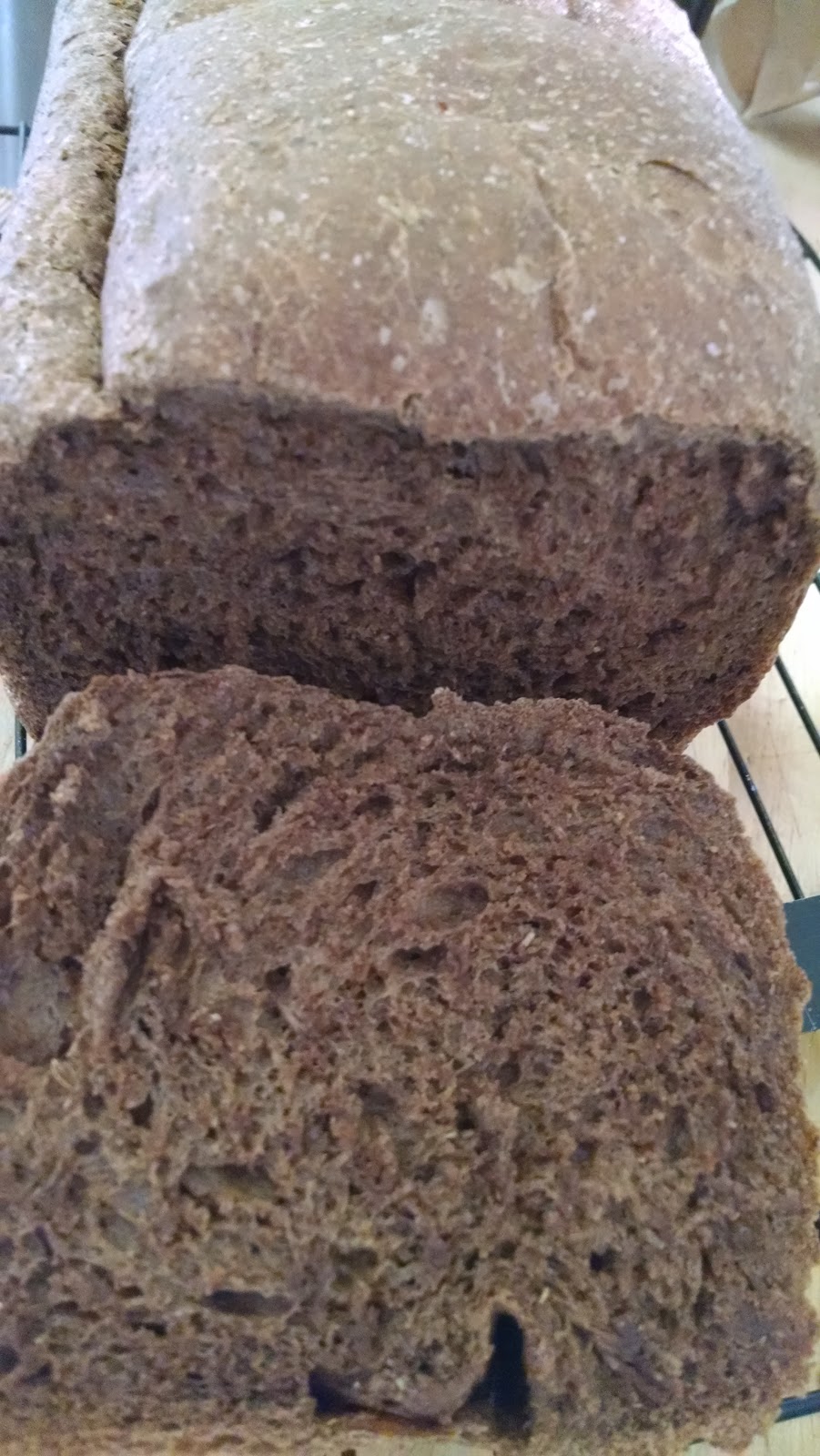
The BBB was much better looking than last time, thanks to using black cocoa.

Dark and out of focus, just the way I like it

The spent grain bread was the same recipe I made the last couple of times. I checked the dough a few minutes into its first rise and noticed that it was very soft and was almost non-existent on the left side of the bread pan. I picked the dough up, as best as I could, and put it back down in a more symmetric shape.

It worked! The loaf was high and symmetric.

Spent grain bread

For future reference, here's the ingredient list, in pan-addition order:
  • Scant 1 cup water, mixed (and, if the grain is cold or tough, microwaved 2 minutes) with 3/4 cup spent grain, firmly packed
  • 2 T olive oil
  • 2 T honey
  • 3/4 t salt
  • 2-1/4 c bread flour
  • 3/4 c whole wheat flour
  • 1 t bread machine yeast
It's best to check the dough's shape when it begins rising, so you can fix the shaping (making it symmetric) if necessary.

Sunday, September 13, 2015

Baguettes and two old standbys

I was away this weekend, but the week before I made baguettes again—successfully!—and a couple of bread machine loaves: toasted sesame and Bohemian black bread (BBB). Then for this weekend, I made the toasted sesame bread again.

Toasted sesame bread #1, uneven as usual (but tasty)

The toasted sesame bread seems to always turn out much higher on one side than the other. I thought maybe it was due to my not sprinkling the salt on evenly, but even when I mixed the salt with the water for loaf #2, the loaf was uneven.

Toasted sesame bread #2, still uneven

Now I'm thinking that perhaps the problem is simply that the bread is 100% whole wheat, and (even on the whole wheat cycle) the bread simply tends to clump around one mixing paddle more than the other.

A possible solution might be to check the dough when the raisin/nut beeps sound, to make sure it's even. It's not a big deal, though. The unevenness doesn't affect the taste or texture at all, just the size.

Toasted sesame is becoming my go-to bread. It's 100% whole wheat, it smells great, and it tastes great with everything except sweet toppings. It's great with tuna or pesto, and very good as a PBJ bread, but not so great with butter & jam or butter & cinnamon sugar.

Inside toasted sesame bread

Last week's Bohemian black bread (BBB) was fairly even, but a bit lower in the middle. I think that might be caused by the dough separating into two halves, each one centered on a mixing paddle. BBB has less whole grain than the sesame bread, fwiw.

Bohemian black bread (BBB)

The BBB was much lighter in color this time, since instead of using black cocoa I used Lake Champlain Chocolates cocoa, which is a light reddish brown. I need to get some more of that black cocoa.

The inside of BBB

On to baguettes.

A week ago Thursday and Saturday, I refreshed the white sourdough starter. Saturday morning I refreshed the whole wheat starter. Sunday I made baguettes.

I used a variant of King Arthur Flour's sourdough baguette recipe, ending up with these ingredients (almost identical to the first batch, except I used all-purpose flour + gluten instead of bread flour):
  • 1/2 cup + 2 T lukewarm water
  • 1 cup sourdough starter (I used white only)
  • 2 1/4 cups all-purpose flour
  • 2 tsp gluten
  • 1 t salt
  • 1/2 T bread machine yeast
I forgot the gluten until a couple of minutes into the mixing. Whoops! Canceled the cycle, added the gluten, and started the dough cycle again.


Around 5:45 I took the dough out, shaped it, and put it in the gheed baker (where gheed is to ghee what oiled is to oil).

I wet a dish towel, put it on a cookie sheet, and then awkwardly dipped the top side of each baguette onto the sheet. I put the largest baguette in the middle. I added raw, whole buckwheat to the top baguette.

From top to bottom: buckwheat, biggest, prettiest

I accidentally turned the oven on before putting the baker in. I didn't realize until it was already hot, but I turned it off while the loaves finished rising.

About to go into the oven

I might have overbaked the bread a little bit, but my family and I liked it. It had a nice crust (though perhaps a little thick) and tasty, tender innards. And it didn't stick to the pan, at all!

Buckwheat covered baguette

We started with the buckwheat-covered baguette. A lot of the buckwheat fell off, but that just made it that much more fun for my daughter and me to go on a little treasure hunt of the cutting board.

The buckwheat-covered baguette didn't last long

The next day we had about 1.5 loaves left, which we used for chicken sandwiches. It was so nice to have a real baguette sandwich again! It made me want to find a recipe for banh mi bread, the craptastic bread that makes a terrific holder for delicious Vietnamese fillings. Here are some recipes that I might try:
Back to traditional baguette recipes, I'm thinking about trying some of the following recipes from King Arthur Flour, all but one of which require an overnight rest:

Wednesday, April 1, 2015

Ice cream cake (again) and a fallen bread

Last weekend I made an ice cream cake and some black bread. Both were fine, although the cake crust was still too hard, and the bread collapsed in the middle.

Ibrahim's birthday cake

I had marching orders for the ice cream cake. It had to have:
  • chocolate ice cream
  • rainbow sprinkles
  • whipped cream (lots of it, sprayed from a can)
I'd rehearsed last week with a yummy malted milk ice cream cake, and I applied what I learned. Most everything worked, but I'll change a couple of things next time:
  • Make the crust thinner; I tried not packing it as tight and cooking it less, but it was still just as hard as before
  • If I use sprinkles again, use bigger ones that aren't round; the tiny round sprinkles bounce everywhere! (I packed them around the side, which looked nice, and we sprinkled a few more on top of the whipped cream.)
And of course, for anyone but my nephew, I'd insist on a different ice cream flavor. Coffee or toasted almond or malted milk or peanut butter would all be great. Shaved or grated chocolate would make a nice coating for the sides and maybe the top.

Bowed Bohemian black bread

I don't know for sure why the Bohemian black bread fell. It did stay in the bread maker for a few hours after it was cooked (oops), but I'd think by then it would be too late to collapse. Maybe not.

Fortunately, it still tasted great. We used it for sandwich bread and out-of-hand eating, as usual, and also for bread crumbs in Sodium Girl's pork & fennel meatloaf. Yum!

Tuesday, February 17, 2015

Improving on two breads

This weekend I made two breads that I'd made before, but that needed improvement: Josey Baker's sesame bread, and Hensperger's Bohemian black bread (BBB). Both breads were delicious the first time around, but had... shall we say... appearance issues.


The sesame bread's ugliness was the result of accidentally folding the dough as I plopped it into a preheated Dutch oven. The BBB's ugliness seemed to be the result of the yeast collapsing—the bread probably rose too high, too soon.

I figured the sesame bread's problems (more details here) would be fixed by using the new baking stone I got for the oven. Some additional help would come from my new proofing basket and bread scorer (aka lame, which rhymes with mom).

Want a lame? Let me know! I have lots of them. They're dangerously sharp, so keep them out of the reach of kids and blindly wandering fingers, but they're good for scoring bread and, I hear, for opening packages.

Sure enough, the new equipment made handling the bread dough easier (although I didn't use the lame this time). The bread looked much better.

Sesame bread that does not look like a monster face

I need to make a few improvements to the process of transferring the bread to the oven. First, make sure the lame's at hand when I need it. (You'd think that after buying a 12-pack, I could find one when I needed it.) Second, use a different pot to cover the bread for the first half of baking. I used a Dutch oven that has handles even with the top, but had a near-disaster when I tried to remove the pot. A lighter pot with handles farther from the top would be much easier to manage. Third, just get better at handling the seeded dough, so seeds don't end up everywhere (on the kitchen floor and counter; all over the oven, popping like popcorn...).

But mostly the transfer/baking process worked pretty well. Using baking parchment to transfer the dough was easy and effective. I removed the parchment halfway through, when I removed the Dutch oven covering the bread.

Backing up a bit, the process of fermenting and mixing the dough was a bit different this time—it was faster. I noticed no difference in flavor, but a few white patches were visible inside the bread. That might be because the dough didn't sit as long as last time, or maybe I just undermixed the dough. (The easiest way to mix is squishing it between your fingers, which is fun, so I should just enjoy that.)

Depending on how long you refrigerate the dough after mixing it or shaping it, this bread can take anywhere from 21 hours to a week, start to finish. (Taking more time is supposed to be better, flavor-wise.) The last time I made this bread, it took 4 days; this time it took a day and a half. I made the pre-ferment Thursday morning, mixed the dough that evening, shaped the loaf Friday morning, and baked Friday afternoon. (I'd worked from home, to avoid exposing coworkers to my cold, so I had more flexible time than I usually do on a weekday.) The amount of time I spent actually working on the bread was minimal—most of the time was just waiting for the yeast beasties to do their thing.

Most importantly, the bread tasted great. I brought it to a friend's house Friday night, where it served as a pre-dinner snack as well as dinner accompaniment. Yay, success! I froze the remaining few slices Saturday night, since this bread went stale quickly the last time we made it.

For the second loaf of bread, Bohemian black bread (BBB), I needed to slow down the yeast beasties to avoid the problems I had the first time. Some ways of slowing the yeast involve adjusting the ingredients:
  • Reducing the yeast
  • Increasing the salt
  • Decreasing the food (sugar, whole grain, ...)

Other ways of slowing down yeast involve time and temperature. I didn't want to mess with those because I wanted to keep this as a simple bread machine recipe.

I ended up reducing the yeast and increasing the salt, along with accidentally increasing the food.
  • Yeast: 1 t instead of the 2.5 t the recipe called for (was 2 scant last time)
  • Salt: 3/4 t instead of 1.5 t (was 1/2 t last time)
  • Molasses: 2 T instead of 1.5 T (oops; I was looking at the wrong ingredient list when I measured this)

I cooked it on whole wheat mode, which is probably what I used last time. I then let it rest overnight, since this bread tastes better the second day.

Bohemian black bread

The bread looks fine (albeit slightly lopsided) and tastes great! I think that increase in molasses might be a good thing. I suspected that part of the bread might have a flying roof (a hollow area just beneath the crust), but after eating half the loaf, I still haven't found any big air pockets.

No flying roof here

What's next? A knitting convention! Which is relevant to bread only in that I'm taking off Thursday to go to an afternoon class. Having Thursday morning free means that I might be able to prepare one of Josey Baker's time-consuming recipes for this weekend. Maybe I'll bake one of his sourdoughs, at last.

Saturday, January 10, 2015

Redemption of a fallen pumpernickel

I love pumpernickel bread, although I didn't know that until I started baking it for myself, using Zojirushi's recipe.

A big, delicious loaf of Zo pumpernickel

I'm not crazy about caraway seeds, but since my honey is, I decided to try a recipe in The Bread Lover's Bread Machine Cookbook (which I'll just call Hensperger, after its author). It's called Bohemian black bread (BBB), and it's a pumpernickel with fennel and caraway.

At first, the bread was a flop. Neither of us liked the flavor much, plus the bread fell! I've never had this problem before, despite all my messing around with the amount of yeast and salt. The bread is perfectly light, so I assume the problem was too much yeast for the amount of salt.

A fallen loaf of Bohemian black bread

The second day, however, both of us really liked the bread. (The recipe had said it was better the second day. Maybe it's because the fennel mellows.) We tried the bread various ways—with olive oil and mustard, plain with a slice of ham, topped with tuna fish salad, toasted with peanut butter and jam—and the combinations were delicious! For some reason, this bread was also easier to slice than the others I've made, so I could eat thinner slices.

Thin slices of the BBB

Since I've successfully cooked Zo's pumpernickel every time I've tried, here are some notes comparing the recipes (or, to be precise, my interpretation of the recipes). I cooked both breads using the delay timer and the whole wheat setting.

Things that are similar:
  • The liquid: both use water (though Zo uses a bit less)
  • The sweetener: both use molasses (though Zo uses more)
  • The coloring: both use cocoa and coffee (though BBB uses more cocoa)
  • The main flours: both use about 2 cups of bread flour, and about a cup of rye flour
  • Salt: both call for 2 teaspoons, though I used just a pinch for the Zo and maybe 3/4 t for the BBB
Things that are different:
  • The fat: Zo uses oil; BBB uses butter (and twice as much, by volume)
  • Other flours: Zo uses some whole wheat flour plus a bit of cornmeal; BBB just uses a bit of wheat bran
  • Gluten: Zo uses almost 3 times as much
  • Seeds: Zo uses none; BBB uses some caraway (though less than in the book's Scandinavian light rye recipe) and a bit of fennel
  • Yeast: Zo calls for 2 tsp (I used 1 heaping tsp); BBB calls for 1 T (I used 2 scant tsp)
Other things that might have made a difference:
  • I used dark rye for BBB instead of the rye flour I usually use
  • I used black cocoa for BBB instead of the regular dutch process I usually use
I might make the recipe again. It's not the best standalone bread, but (on the second day, at least) it combines really well with other flavors. If I make it again, I'll try lowering the yeast to 1 heaping tsp. Or I might just make the Zo recipe, but add caraway.